Title here
Summary here
November 4, 20254 minutes
Did you know that Trevor Noah has been writing kid’s book? Given that our kids are learning about apartheid every year, can we add more voices to their education?
FYI [Affiliate links below. All earnings will go toward keeping the site up. We would rather not have to move to a subscription model]
So the Trevor Noah, wrote bout his childhood in a book called, “Born a Crime.” Born a crime is a fascinating book that revolved Trevor’s early life. Born a Crime went on to be a #1 best-seller and it is slated to hit the big screen at some point (soon I hope). Mr. Noah started his work in children’s literature adapting . We have it at home and we think its great. Mr. Noah touches some difficult topics in a respectful but lighthearted manner. Here is the common sense media page covering the book:
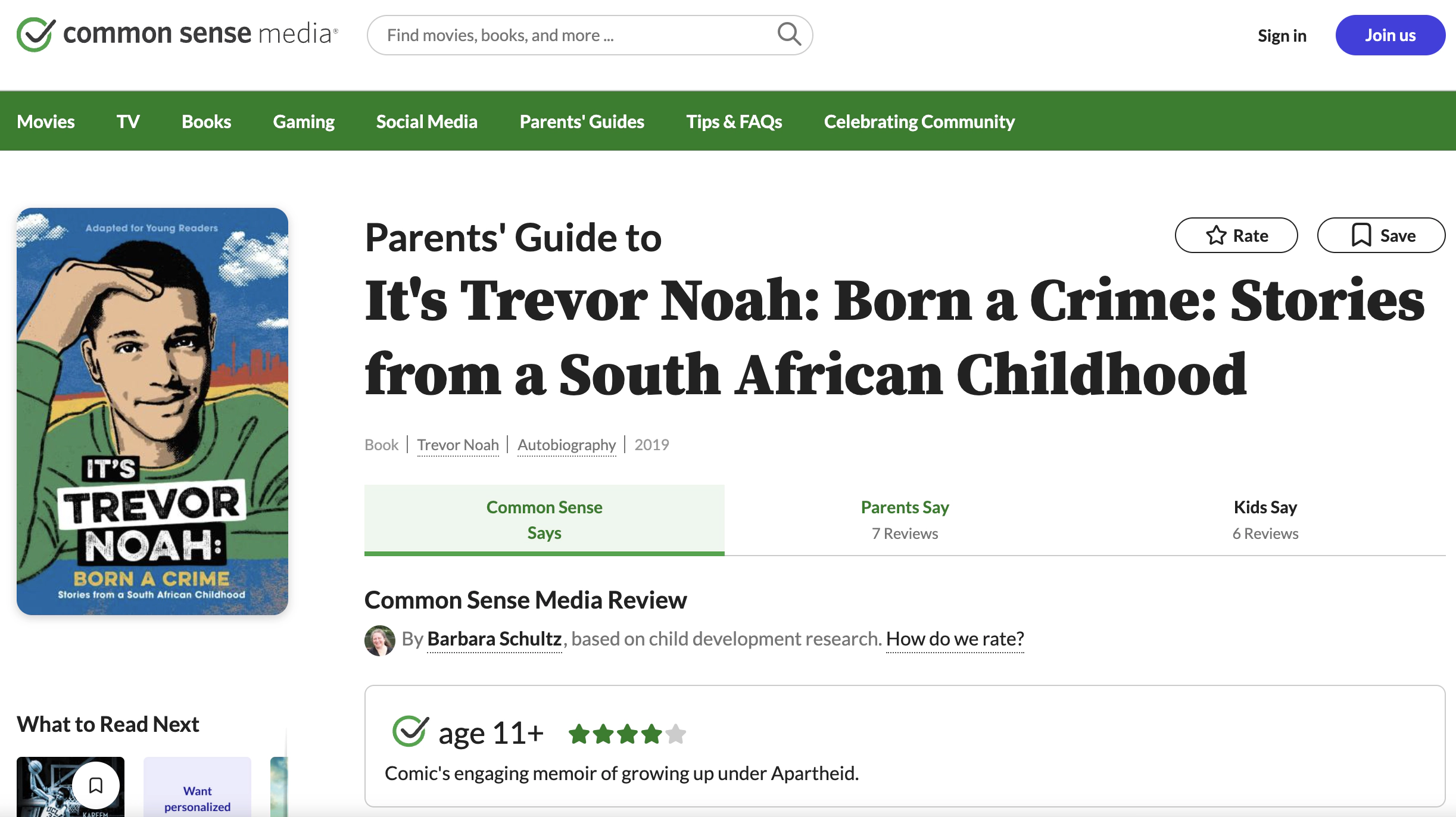
Trevor’s account of growing up in South Africa as a “coloured child” shows love for both his White father and Black mother. Did you know that Trevors his family was caught, his family of they would be forced to live in three different neighborhods? No book or author is perfect but I am not sure that teaching kids about apartheid has ever been done better. Here is Trevor telling an amazing story about his grandmother Gogo. Link
Time and time again Mr. Noah teaches us that South Africa is very matriarcal. Wathint’ abafazi, wathint’ imbokodo is a South African phrase that means, “If you strike a woman, you strike a rock.” Based on some of our recent issues in our high schools, this might be a great lesson to incorporate into our classrooms as early as possible!
If you weren’t aware, our kids learn from several books based on childhood experiecnes under Apartheid. While many of Ann Cameron’s books depict black children on their covers, Ann herself is a white woman who grew up in Wisconson in the 1940s so she needed to pull many of her stories from someone else’s childhood.

If the Julian books give you strong 80’s Vibes… you are 100% correct. Ann started publishing these gems in the early 1880’s 1980’s!
As highlighted here: “Ann’s books about Julian Bates and his family found their beginning in stories told her by a South African friend, Julian De Wette.”

Like all South Africans who migrate to the USA from SA (including Trevor Noah and Elon Musk), the real Julian can accurately be described as an African-American. Furthermore, the real Julian is also an author and he writes about a variety of topics including his own childhood. Here is one of his poems covering his First Day of School. If there is an interest in learning more about the real Julian, take a look online or send us a note at . Since you made it this far…
In the short story, ``The Pudding Like a Night on the Sea’’ Julian’s father, Mr. De Wette, talks about whipping and beating his kids a lot! The tell that this isn’t a black american family is specifically in the whipping portion of the fathers gag. For black american families whose ancestors were enslaved, the whip is a canonical symbol of salvery. Whips and nooses are two items that I have not known to be part of jovial dialogue between black fathers and their children.
The use of whips actually contributed to a perjorative term that I learned when I was growing up. If you aren’t familiar with the term, here is a hint: it’s an Onomatopoeia for someone who would use a whip often. They
Still stumped? Below is a famous an SNL skit called “Word Association” where Richard Pryor uses the (anti-whiping) term with Chevy Chase. The plot is that a word assiciation game turns into many unkind racial slurs being exchanged between an interviewer and an interviewee.
WARNING:
Until next time!
Will